King Muryeong's Tomb and Gongju National Museum: Follow the Story from Mound to Gold
Korearoadtour · Original · CC BY-SA 4.0 ·
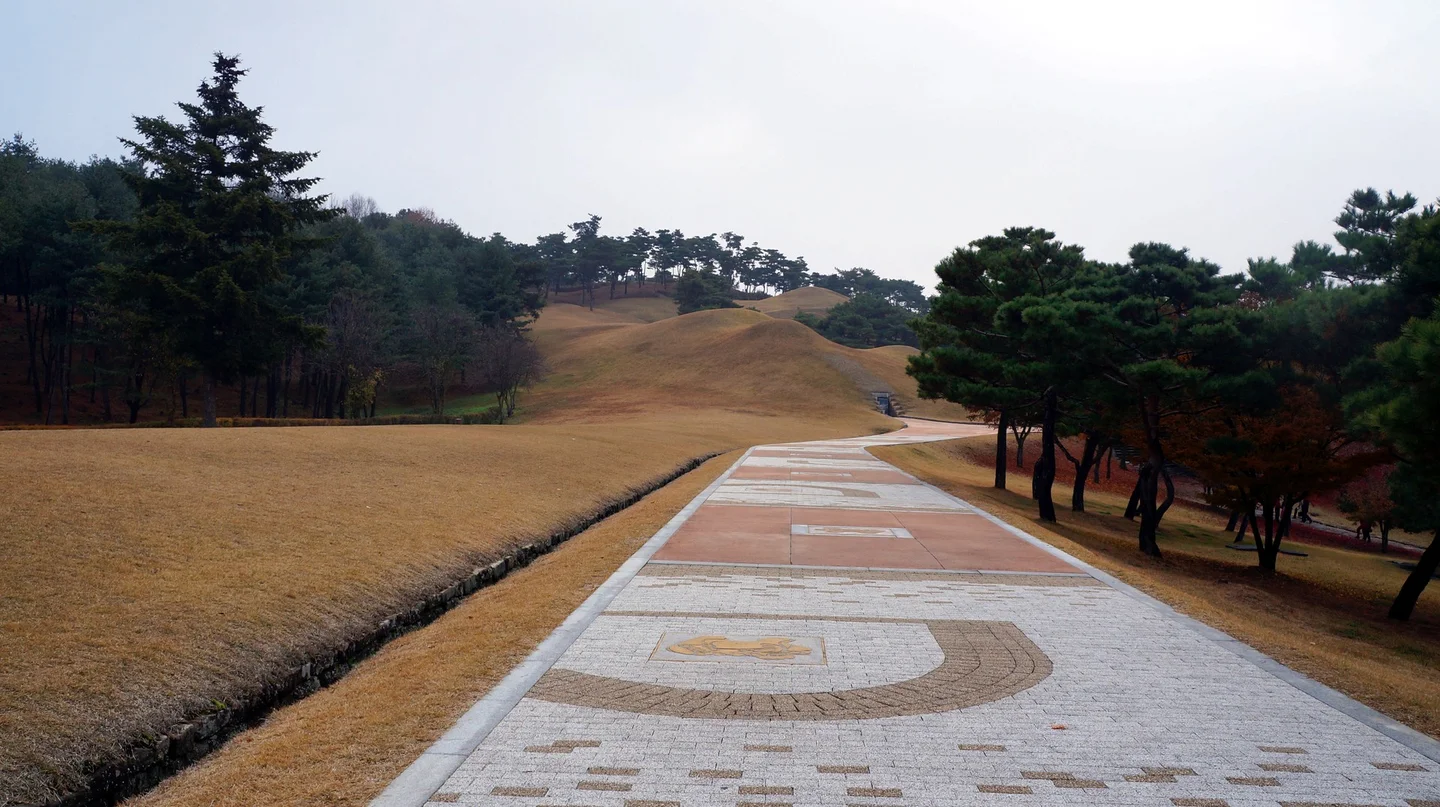
Gongju's royal tombs and national museum tell two halves of the same story. At the tomb complex, grassy mounds and reconstructed burial chambers show where and how Baekje royalty was buried. At the museum nearby, objects recovered from King Muryeong's tomb reveal the people, craftsmanship, and beliefs behind those quiet slopes. Seeing both places gives the outing a clear thread. Begin with the tomb-site exhibitions and a walk among the mounds, then continue to the museum's Ungjin Baekje Hall. If rain or strong heat makes outdoor walking less appealing, reverse the order and adjust the time outside. Check the two sites separately, since their admission arrangements and closing days differ. Three questions make useful guides: who was buried here, how was the chamber built, and what accompanied the occupants? They lead naturally from the landscape to the architecture and then to the small, intricate things that survived inside.
The Tomb You See and the Chamber You Can Explore
Ryuch · Original · CC BY-SA 3.0 ·
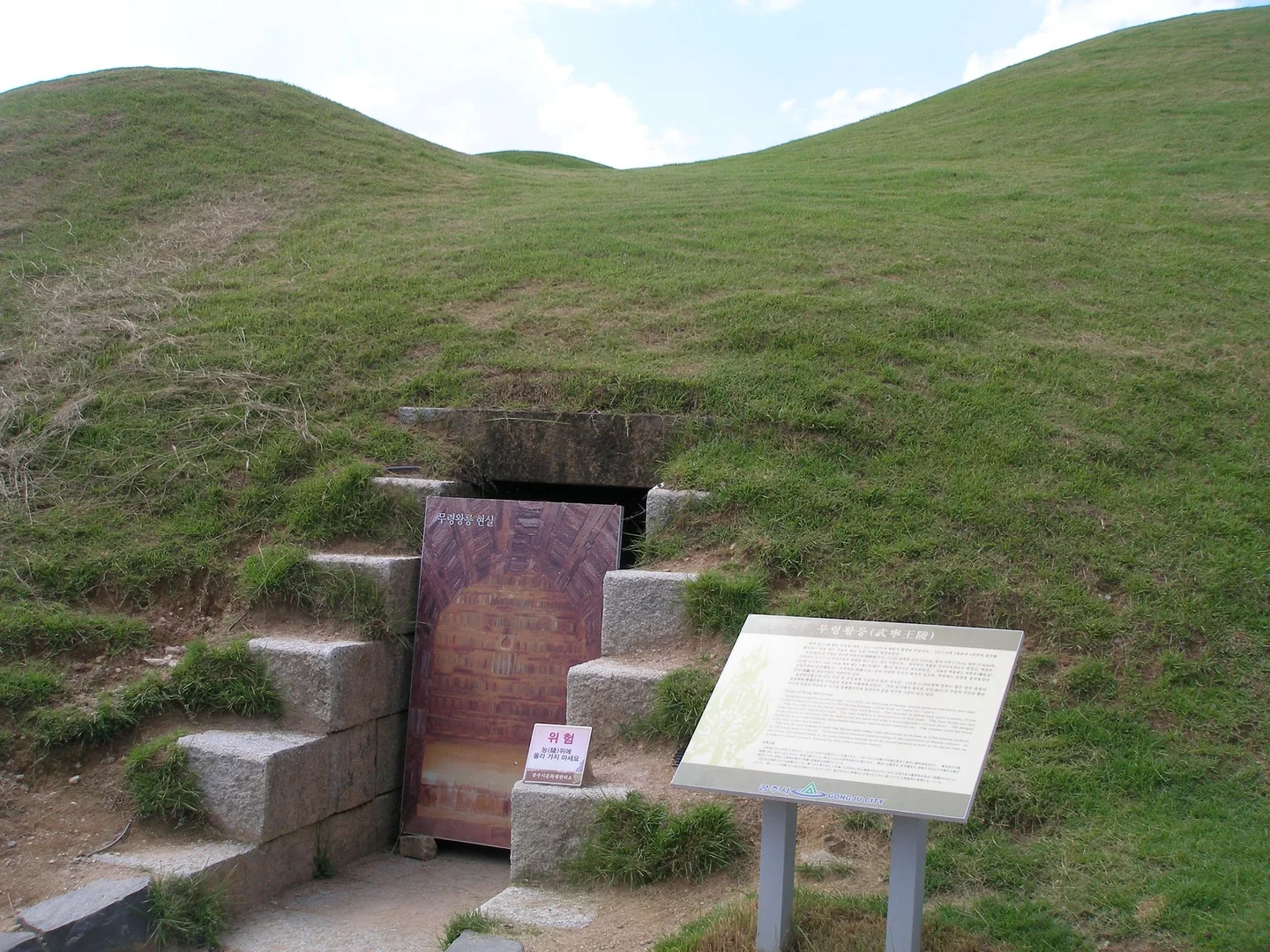
The site now called the Tomb of King Muryeong and Royal Tombs was formerly known as the Songsan-ri tomb complex. The older name still appears in historical accounts. Use the current site name to find the entrance and visitor facilities. The original interior of King Muryeong's tomb is closed to ordinary visitors for conservation. Instead, the exhibition presents a reconstruction of the chamber and its passage. This lets you understand the space without entering the original burial environment beneath the mound. Look at the way the brickwork forms the walls and ceiling, then follow the relationship between the entrance passage and burial chamber. Where several reconstructed tomb types are presented, read the number or name: the site's stone-chamber and brick tombs are not all examples of Muryeong's own design. Outside, paths connect the rounded mounds through lawns and trees. Stay on those routes rather than climbing the grass-covered tombs. The changes in slope are part of the landscape, so allow for more walking than a quick look at an entrance might suggest. Muryeong's tomb came to light during drainage work in 1971. Stone epitaphs helped identify the king and queen buried there. That surviving written evidence is a central reason the discovery matters, and it is worth keeping in mind when you later see the inscribed stones and other objects at the museum.
Continue to Gongju National Museum
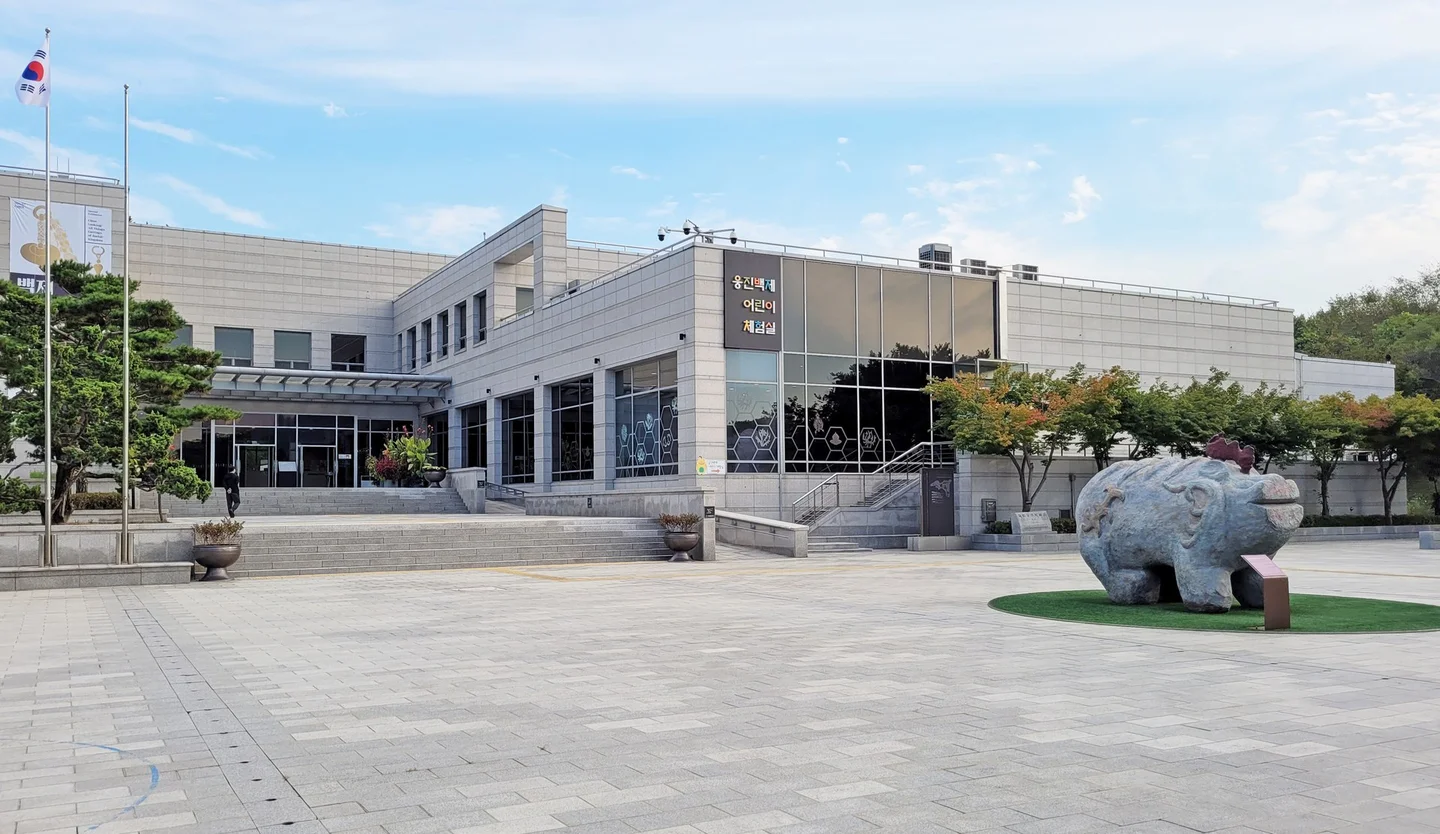
The tomb complex and museum can be linked on foot, including by a connecting wooded route. Check the entrance-to-entrance path that suits your group rather than judging the walk only by the distance between map pins. The time already spent around the mounds counts too. If you leave a car at one site, include the walk back at the end. From Gongju's bus terminal, local buses and taxis provide access to this part of the city. The museum's official directions distinguish a service reaching the museum from one that leaves an additional walk from the Culture and Arts Center. Check the actual stop when choosing a bus, especially with luggage or limited mobility. As checked October 12, 2026, Gongju National Museum opens from 9 a.m. to 6 p.m., with free permanent-gallery admission. Special exhibitions may have separate charges. It closes Mondays, January 1, Seollal, and Chuseok; when Monday is a public holiday, the closure moves to the first weekday after the holiday. Do not rely on older references to evening opening, which the current guide lists as suspended. At the tomb complex, the city's current guide lists 9 a.m.–6 p.m. March through October and 9 a.m.–5 p.m. November through February, with entry ending 30 minutes before closing. Its admission is separate from the museum's. For a late arrival, visit the place with the earlier cutoff first rather than following a fixed order.
Look Closely at the Royal Ornaments
National Museum of Korea · Original · KOGL Type 1 ·
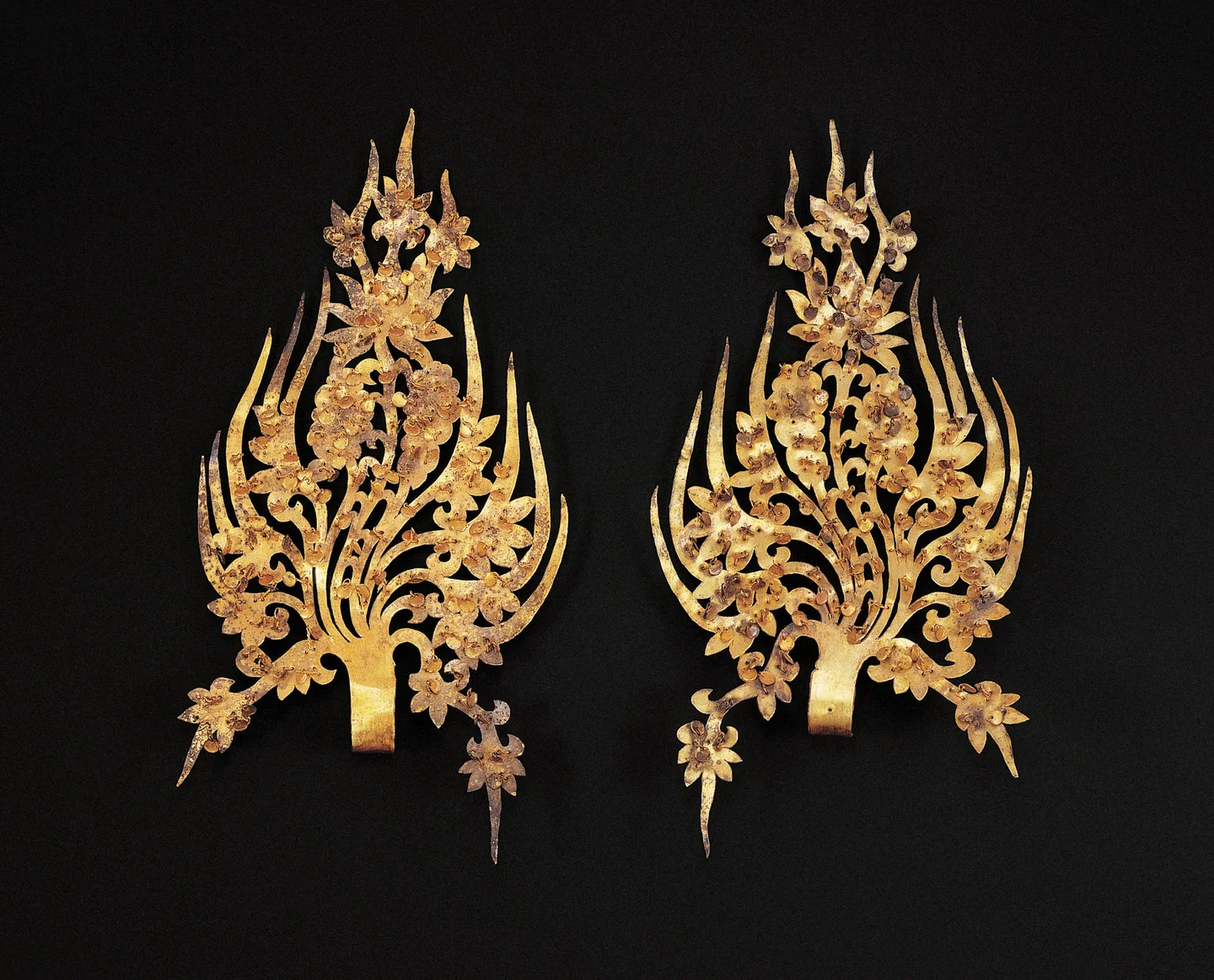
The king's gold crown ornaments are a pair of elaborate decorations rather than an entire freestanding crown. Fine openwork shapes branch upward from thin gold sheets, with floral and curling forms and small attached pieces. Give them a close look: the effect comes from the delicate cutting and construction as much as from the material's brightness. The national heritage record notes that they were discovered near the king's head inside his coffin. Knowing their position helps turn them from beautiful museum objects into parts of royal dress. Compare the two ornaments and see how their lines and details correspond.
National Museum of Korea · Original · KOGL Type 1 ·
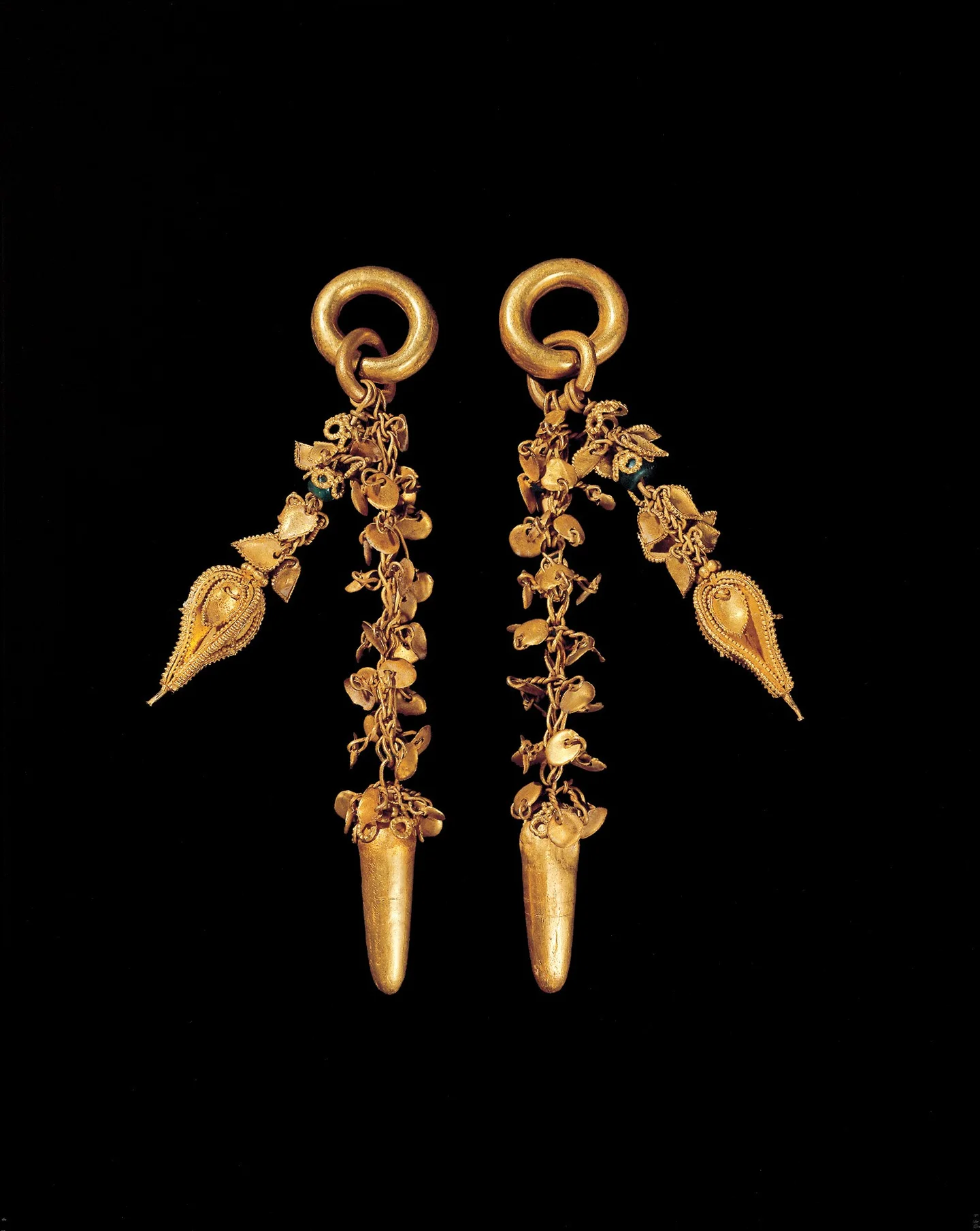
The queen's gold earrings offer another scale of craftsmanship. Rings, small linked forms, and long hanging elements make a complex arrangement within a small object. Look at how the pieces connect, and read the label for the object's identity and burial context. The Ungjin Baekje Hall brings these royal discoveries into a broader account of the period when Gongju, then called Ungjin, was Baekje's capital. Prioritize that hall if the tomb is the theme of your visit. With more time, add the regional history galleries and outdoor stone works rather than trying to give every section the same amount of attention.
The Stones That Named the Occupants
The epitaphs are less glittering than the jewelry, but they preserve information that the ornaments alone cannot provide. Their inscriptions identify the tomb's occupants and record details of the burial. Use the translated interpretation to follow the significance of the writing, even if you cannot read the original characters. Another memorable discovery is the jinmyosu, an imaginary guardian animal placed in the tomb. Its compact body, legs, and horned head suggest several familiar creatures without resolving into just one. Think about its role as a protector rather than trying to identify it as a real species. The museum's display also helps explain where objects stood in relation to the passage, chamber, and coffins. This is where the earlier visit to the reconstructed tomb becomes useful: the things in the cases now belong to a space you can picture. Check labels for originals and reproductions, and ask ahead if one particular artifact is essential to your visit. Loans, conservation, or gallery changes can affect individual displays. Follow the photography instructions; the museum prohibits flash and tripods.
A Family Visit with Time to Pause
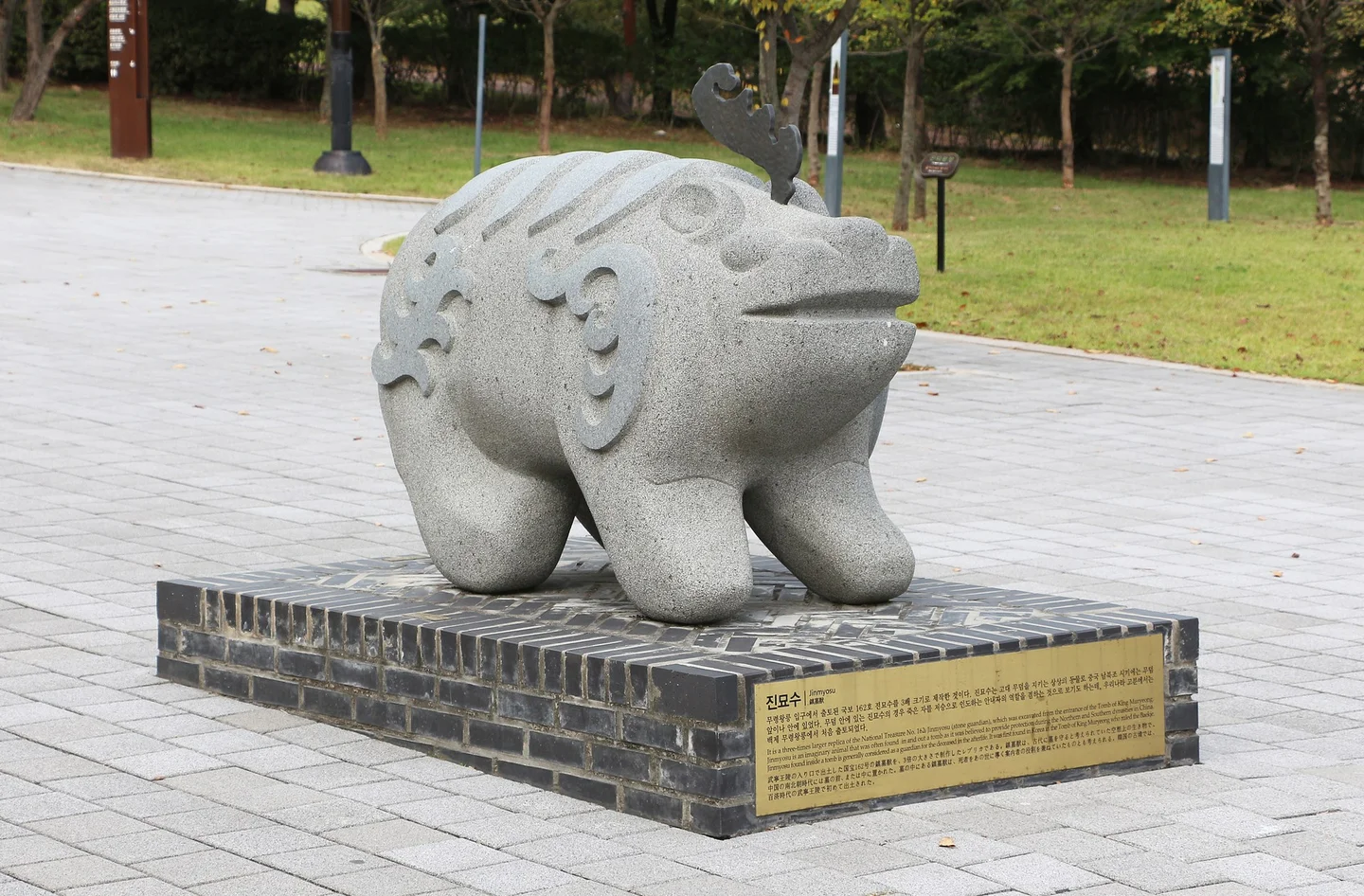
The guardian-animal sculpture outside offers a larger, approachable version of the jinmyosu form. It is a modern reproduction, separate from the excavated artifact. Children can compare what they remember from the gallery with the outdoor figure while taking a break from reading labels. For a more structured activity, the Ungjin Baekje Children's Experience Room requires advance online reservations and an accompanying adult, according to the current museum guide. Check the age guidance and session before arranging the rest of the museum visit. Free gallery admission does not remove that booking requirement. Place a meal before or after the paired sites, with the nearby Gongju Hanok Village area or downtown as possible next stops. If you want to continue to Gongsanseong Fortress, treat its sloping wall paths as another substantial walk. After the tomb landscape and museum galleries, a meal may be a better next step than adding more climbing.