gil.KOREA

Sosu Seowon: an old academy, pine woods, and a streamside walk
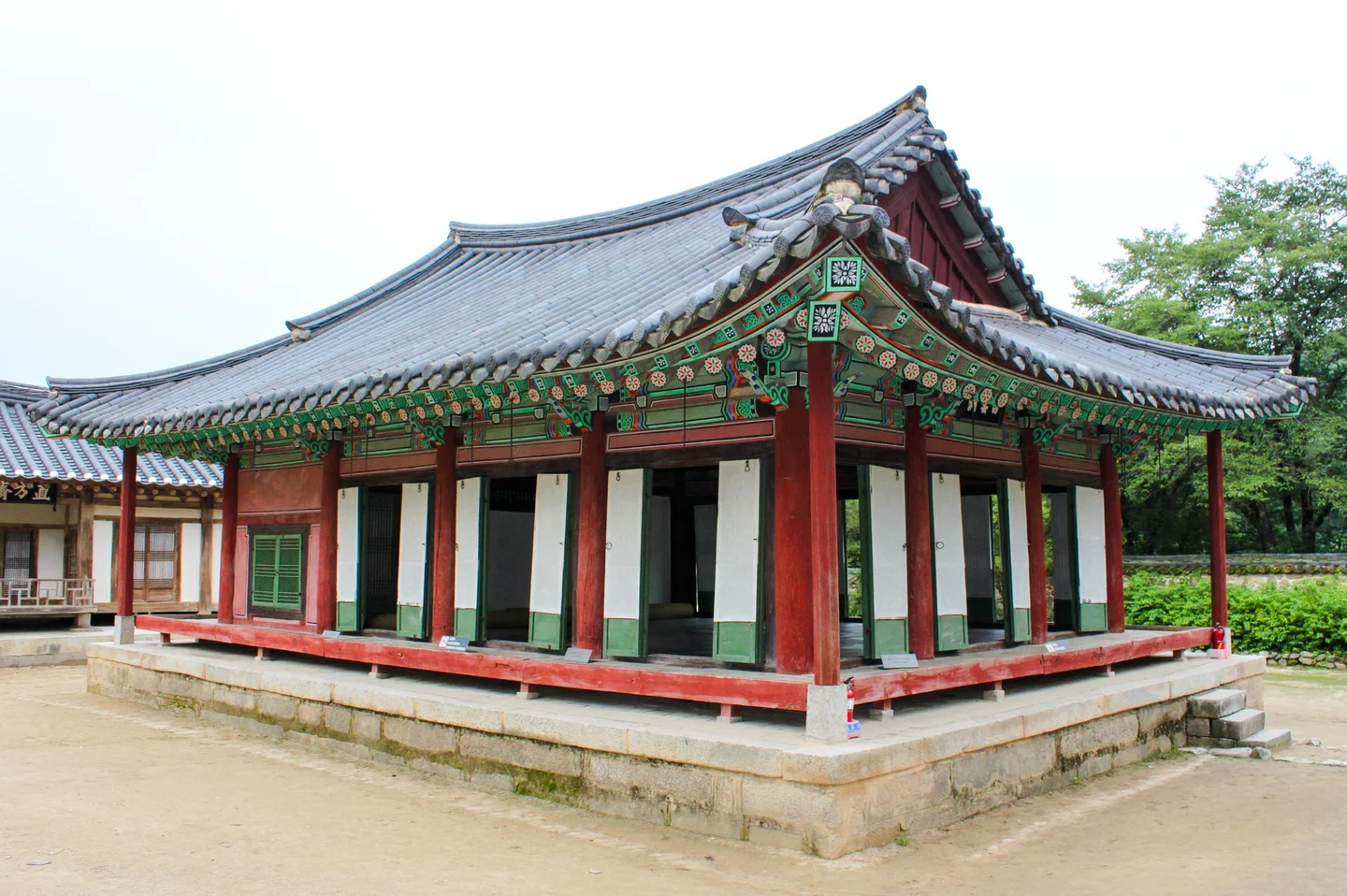
Open lecture hall and courtyard at Sosuseowon Confucian Academy

Kwkhh · Original · CC BY-SA 4.0 ·

Source notices and processing details

Open lecture hall and courtyard at Sosuseowon Confucian Academy

Photo: Kwkhh · commons.wikimedia.org — 소수서원 강학당.jpg · CC BY-SA 4.0

WebP conversion; proportionally reduced where needed; no cropping or upscaling.

Processed copies are provided under the same license shown above.

CC BY-SA 4.0 https://creativecommons.org/licenses/by-sa/4.0 · 저작자 표시 필수 · 동일조건변경허락(변경 시 같은 라이선스)

360 × 240: Existing supplied proportional WebP rendition; no new crop, resize, upscaling, distortion or synthesis in this connection batch.

720 × 479: Existing supplied proportional WebP rendition; no new crop, resize, upscaling, distortion or synthesis in this connection batch.

1440 × 958: Existing supplied proportional WebP rendition; no new crop, resize, upscaling, distortion or synthesis in this connection batch.

At Sosu Seowon, a lesson in Korean history comes with a walk beside the water. The lecture hall sits close to smaller study buildings, while pine trees and Jukgyecheon Stream soften the edges of the academy. It is an appealing stop in Yeongju if you like historic architecture but also want time outdoors, without the sustained climb of nearby Buseoksa Temple. The key to the place is that a seowon did more than teach. Scholars studied here, honored earlier thinkers, and treated the surrounding landscape as part of intellectual life. Sosu Seowon is one of the nine academies inscribed together on UNESCO’s World Heritage List in 2019. Its courtyards, shrine, and waterside pavilions let you see those different functions within a relatively compact visit. Plan around the academy, the stream, and Sosu Museum. About two hours on site is a reasonable starting estimate; allow longer if you enjoy museum displays or want an unhurried walk.

Arriving in Sunheung and getting your bearings
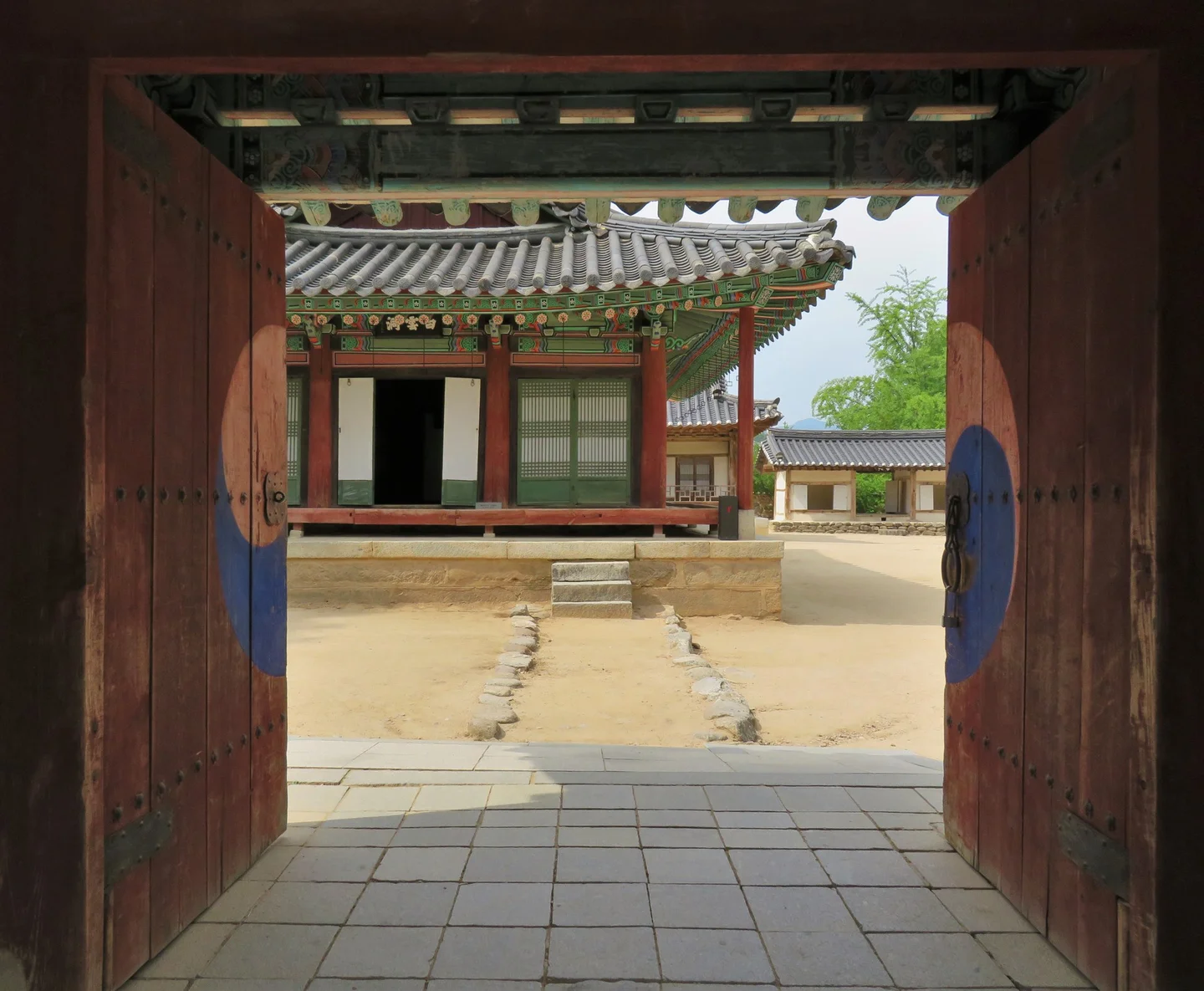
Sosuseowon inner courtyard viewed through a main gate

Kyle · Original · CC BY 2.0 ·

Source notices and processing details

Sosuseowon inner courtyard viewed through a main gate

Photo: Kyle · commons.wikimedia.org — Sosu Seowon (3).jpg · CC BY 2.0

WebP conversion; proportionally reduced where needed; no cropping or upscaling.

CC BY 2.0 https://creativecommons.org/licenses/by/2.0 · 저작자 표시 필수

360 × 296: Existing supplied proportional WebP rendition; no new crop, resize, upscaling, distortion or synthesis in this connection batch.

720 × 592: Existing supplied proportional WebP rendition; no new crop, resize, upscaling, distortion or synthesis in this connection batch.

1440 × 1185: Existing supplied proportional WebP rendition; no new crop, resize, upscaling, distortion or synthesis in this connection batch.

Sosu Seowon is in Sunheung, north of central Yeongju. Use Sosu Seowon itself as the destination when arranging a taxi or navigating by car. Visitors arriving by rail should plan the local connection from Punggi or Yeongju rather than expecting to walk from the railroad station to the academy. Yeongju’s current bus table lists route 27 toward Buseoksa via Punggi and Sunheung. Check the stop serving Sosu Seowon, the direction of travel, and the return departure before boarding. The departure location used in the city timetable is not automatically the railroad station. If you hope to visit Buseoksa on the same day, compare both onward and return connections before deciding the order. The official hours, checked October 12, 2026, begin at 9 a.m. year-round. Closing is 6 p.m. in March–May and September–October, 7 p.m. in June–August, and 5 p.m. in November–February. Last admission is one hour before closing. An October arrival at 5 p.m. therefore leaves much less time than you need for a relaxed academy-and-museum visit. Pick up a site map at the entrance. It helps distinguish the historic academy from the museum and neighboring cultural facilities, especially where their names appear together on admission information. Bicycles and pets are not admitted under the published visitor rules. If you need step-free access, ask about a suitable route: paths between buildings and access to their raised floors are different questions. VISITKOREA’s English page shows closing times an hour earlier. This guide follows the academy’s own seasonal table and its 2026 winter notice; recheck the academy’s latest notice before traveling.

A royal name and rooms for learning
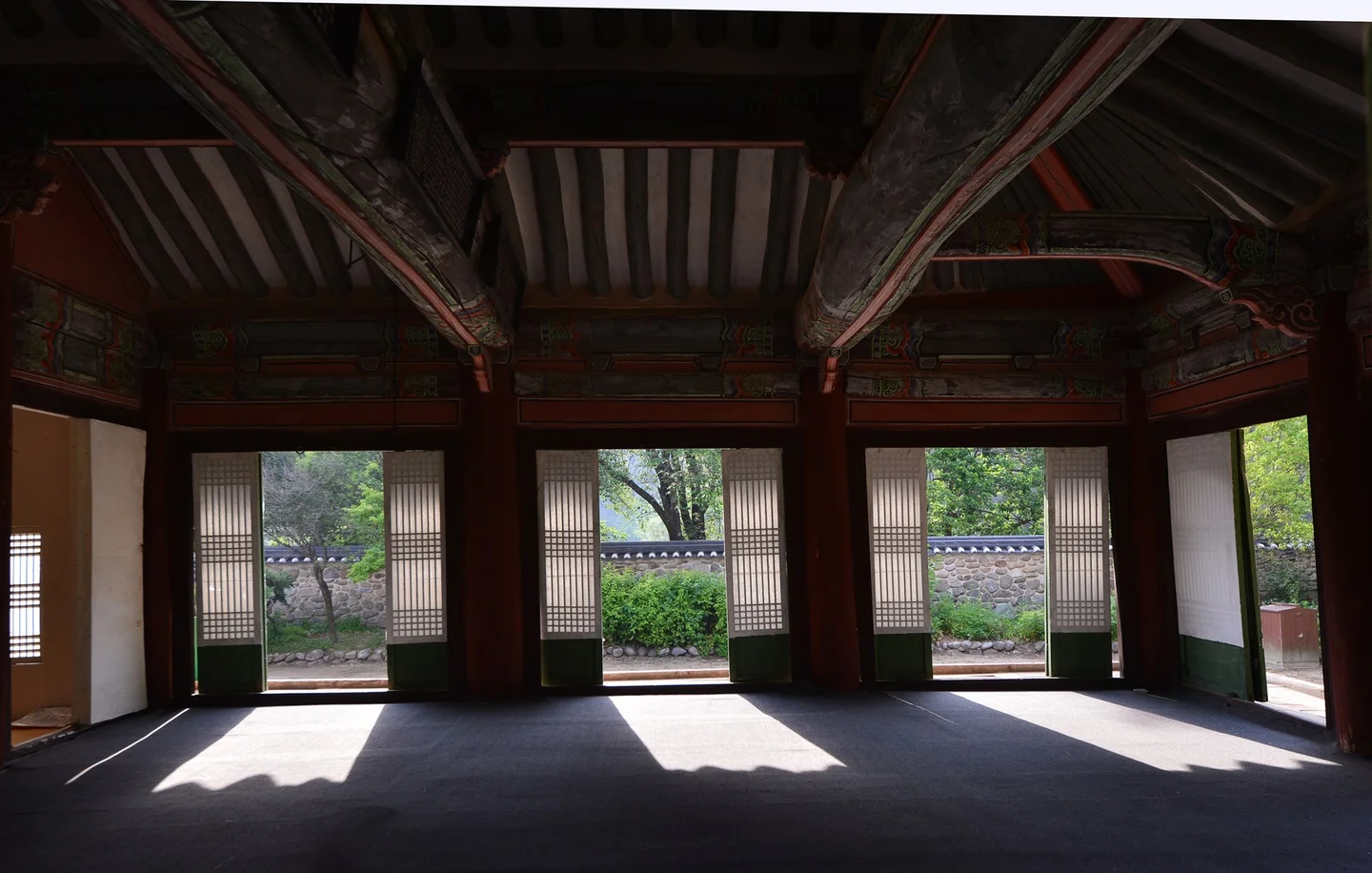
Interior of Sosuseowon’s main hall, with a wall beyond the open doorway

손묵광 · Original · CC BY-SA 4.0 ·

Source notices and processing details

Interior of Sosuseowon’s main hall, with a wall beyond the open doorway

Photo: 손묵광 · commons.wikimedia.org — 소수서원.jpg · CC BY-SA 4.0

WebP conversion; proportionally reduced where needed; no cropping or upscaling.

Processed copies are provided under the same license shown above.

CC BY-SA 4.0 https://creativecommons.org/licenses/by-sa/4.0 · 저작자 표시 필수 · 동일조건변경허락(변경 시 같은 라이선스)

360 × 229: Existing supplied proportional WebP rendition; no new crop, resize, upscaling, distortion or synthesis in this connection batch.

720 × 458: Existing supplied proportional WebP rendition; no new crop, resize, upscaling, distortion or synthesis in this connection batch.

1440 × 916: Existing supplied proportional WebP rendition; no new crop, resize, upscaling, distortion or synthesis in this connection batch.

Sosu Seowon began with a shrine. In 1542, the official Ju Se-bung established a place to honor An Hyang, a scholar associated with the introduction of Neo-Confucian thought to Korea. An academy followed in 1543 under the name Baegundong. In 1550, royal recognition brought the name Sosu Seowon and a royal nameboard. It became Korea’s first royally chartered seowon. That history explains why teaching and commemoration share the grounds. Ganghakdang was the lecture hall, where students gathered for instruction. Munseonggongmyo is the shrine honoring An Hyang and other scholars. Learning and respect for earlier scholars were closely connected here. Ganghakdang rewards a close look at the relationship between indoors and outdoors. Open doorways bring daylight across the floor, and the wooden posts divide views toward the courtyard and enclosing wall. From the permitted viewing areas, follow the exposed beams overhead and the rhythm of the doors. The building feels much more intimate than its formal role might suggest. Around it, smaller structures served study, lodging, administration, and book storage. Jangseogak was the book repository; Hakgujae and Jirakjae provided student lodging. Use the map and room labels to connect each space with an activity. The point is to imagine a working academic community, with daily routines spread across several buildings rather than concentrated in one monumental hall.

Jukgyecheon: where the landscape becomes part of the visit
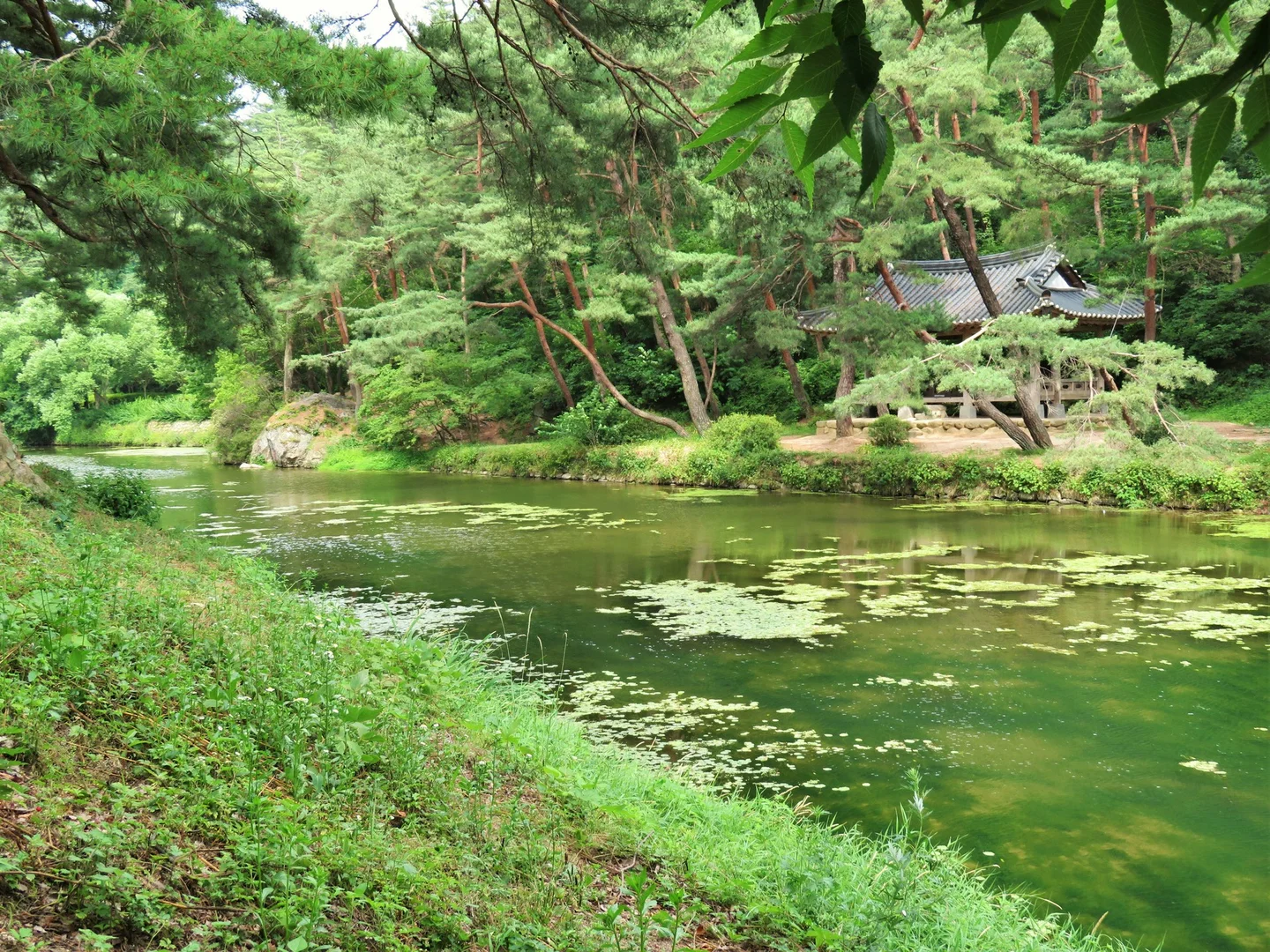
Traditional building between the Jukgyecheon stream and pine grove

Kyle · Original · CC BY 2.0 ·

Source notices and processing details

Traditional building between the Jukgyecheon stream and pine grove

Photo: Kyle · commons.wikimedia.org — Sosu Seowon (1).jpg · CC BY 2.0

WebP conversion; proportionally reduced where needed; no cropping or upscaling.

CC BY 2.0 https://creativecommons.org/licenses/by/2.0 · 저작자 표시 필수

360 × 270: Existing supplied proportional WebP rendition; no new crop, resize, upscaling, distortion or synthesis in this connection batch.

720 × 540: Existing supplied proportional WebP rendition; no new crop, resize, upscaling, distortion or synthesis in this connection batch.

1440 × 1080: Existing supplied proportional WebP rendition; no new crop, resize, upscaling, distortion or synthesis in this connection batch.

Leave time for the stream after the central courtyard. Along Jukgyecheon, pine trunks lean at different angles above the water, with tiled pavilion roofs appearing between the branches. The change from enclosed rooms to a broader landscape is one of Sosu Seowon’s strongest attractions. It also helps explain why this setting mattered to the scholars who used it. Gyeongnyeomjeong was a place for discussion and reflection. Across the water, Chwihandae provides another connection between scholarship and scenery; its name is associated with the scholar Yi Hwang. You can appreciate the pavilions as places positioned to look outward, with the stream and wooded banks forming part of their surroundings.
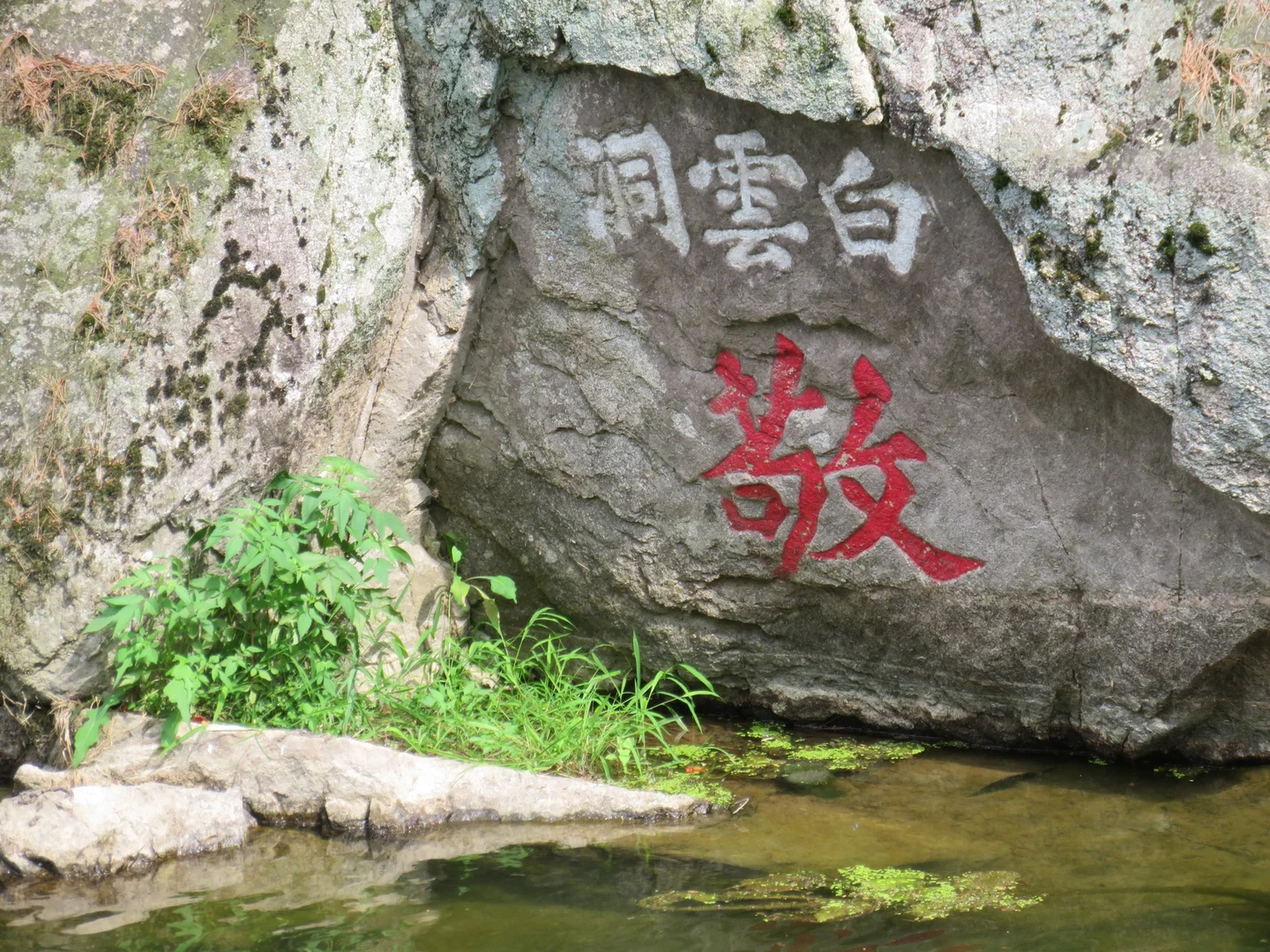
Gyeongjabi Rock engraved with the characters “Gyeong” and “Baegundong”

Kyle · Original · CC BY 2.0 ·

Source notices and processing details

Gyeongjabi Rock engraved with the characters “Gyeong” and “Baegundong”

Photo: Kyle · commons.wikimedia.org — Sosu Seowon (2).jpg · CC BY 2.0

WebP conversion; proportionally reduced where needed; no cropping or upscaling.

CC BY 2.0 https://creativecommons.org/licenses/by/2.0 · 저작자 표시 필수

360 × 270: Existing supplied proportional WebP rendition; no new crop, resize, upscaling, distortion or synthesis in this connection batch.

720 × 540: Existing supplied proportional WebP rendition; no new crop, resize, upscaling, distortion or synthesis in this connection batch.

1440 × 1080: Existing supplied proportional WebP rendition; no new crop, resize, upscaling, distortion or synthesis in this connection batch.

Look for the inscribed rock near the water. The large red character gyeong, 敬, points to an ideal of reverence and disciplined attention. The characters above it read Baegundong, recalling the academy’s original name. These are useful details to seek out because they connect a natural feature with the history you have just encountered in the buildings. Stay on the designated viewing paths around the stream. There is no need to step onto the waterside rocks to understand the inscriptions or enjoy the setting. On a wet day, keep the outdoor portion shorter and give more time to the museum; the trees do not provide continuous shelter.

Sosu Museum and what to add afterward

Sosu Museum gives the visit a human dimension. Its current gallery sequence covers the arrival of Neo-Confucianism, the academy’s history, its teaching and commemorative practices, and the life of a seonbi, an educated scholar associated with ideals of learning and personal integrity. After walking through the grounds, you have real rooms and courtyards to connect with those explanations. The displays also address how the academy was run. This is a useful subject to focus on if the many Korean names feel unfamiliar: who studied here, how learning was organized, and how respect for earlier scholars shaped the institution. You can begin with the museum if that background will make the outdoor visit more rewarding, or save it for the end to answer questions raised by the architecture. Seonbichon is a separate reconstructed village nearby. A March 2026 notice says its visits and traditional-house experiences are suspended until renovation is complete, while Sosu Seowon and Sosu Museum operate normally. The notice remained in place at the October research check. Check for a reopening before adding village activities to your visit. Seonbi World, another nearby attraction, is also a separate facility, focused on cultural experiences. For a heritage-centered day, Buseoksa is the stronger complement: an academy beside a stream followed by a Buddhist temple rising up a mountainside. With limited time or awkward bus connections, stay with Sosu Seowon and its museum, then return toward Punggi or Yeongju for your train.

SourcesUNESCO directly read: nine Neo-Confucian academies including Sosu, 2019 inscription, learning/veneration/landscape functions: https://whc.unesco.org/en/list/1498 Operator introduction directly read via TinyFish: 1542 shrine, 1543 academy, 1550 royal name, main buildings and separate museum/facilities: https://www.yeongju.go.kr/open_content/sosuseowon/page.do?mnu_uid=3331 Operator visitor page directly read via TinyFish October12: precise seasonal hours, one-hour last admission, bicycle and pet restriction; current discounted fare omitted as temporary: https://www.yeongju.go.kr/open_content/sosuseowon/page.do?mnu_uid=3334 Operator current gallery sequence directly read via TinyFish: Neo-Confucianism, academy history/operation/teaching/rites, seonbi life; 2024 reopened layout rather than pre2023 virtual tour: https://www.yeongju.go.kr/open_content/sosuseowon/page.do?mnu_uid=3341 Operator March20 2026 notice body directly read via TinyFish: village and traditional-house experiences suspended since Nov12 2025 until renovation complete, academy and museum explicitly normal: https://www.yeongju.go.kr/sunbichon/page.do?mnu_code=sc0501&bod_sn=222&cmd=2 KTO May2025 feature directly read for stable architecture/stream/pavilions/inscriptions, not obsolete event or neighboring-facility prices: https://korean.visitkorea.or.kr/detail/rem_detail.do?cotid=3ca93592-04cf-4595-9133-1d380f954c7d Yeongju bus table directly read during preceding Buseoksa research:27PunggiSunheungBuseoksa; departure point not assumed rail station: https://www.yeongju.go.kr/open_content/main/page.do?mnu_uid=4098 City academy description official search-index text read: royal charter and higher learning, named buildings; direct standard web hit firewall page: https://www.yeongju.go.kr/open_content/tour/page.do?cmd=2&code_uid=283&con_uid=656&mnu_uid=11840 Official map page directly read as available visitor resource; linked map image failed, no claim to have inspected map image: https://www.yeongju.go.kr/open_content/sosuseowon/page.do?mnu_uid=11799 Student residential buildings corroborated in Korea Heritage Agency Foundation official search-index text; not a current interior-access guarantee: https://uci.k-heritage.tv/resolver/I801%3A1610006-001-V00005 확인일: 2026-10-12 (Asia/Seoul). 기본 근거: gyeongbuk-daegu-021 한국어 완료 원고의 사실·선택 사진. 영어는 독립 구성·집필. 2026-10-25 최종 검수: 공식검색수신27(풍기·순흥)·55(진우·상석)노선 일치.28은 공공형 주말/공휴일관광노선이라 중국어2본문에 누락조건추가. 부석사식당 시메뉴2인분/1인분 구분확인(최소주문으로단정안함). 소수서원 공식검색 11~2월09~17 및입장16시까지 확인. 기지떡KTO원문 직접확인, 전통조리설명과개별상품성분구분. 영주시직접접근은방화벽차단이므로 검색수신을 직접조회로표현하지않음. https://www.yeongju.go.kr/open_content/main/page.do?mnu_uid=4098 https://www.yjkhyo.kr/khyo/page.do?mnu_code=KMN0106 https://www.yeongju.go.kr/open_content/main/page.do?mnu_uid=1521&srchBgpUid=42 https://www.yeongju.go.kr/open_content/tour/page.do?cmd=2&code_uid=262&con_uid=1783&mnu_uid=10770 https://korean.visitkorea.or.kr/detail/rem_detail.do?cotid=4c5d3ef5-1f7d-4f1c-b507-0988944d85b7 https://www.yeongju.go.kr/open_content/sosuseowon/page.do?mnu_uid=3334 https://www.yeongju.go.kr/open_content/sosuseowon/page.do?mnu_uid=3348&parm_bod_uid=1220361&step=258

Travel guide