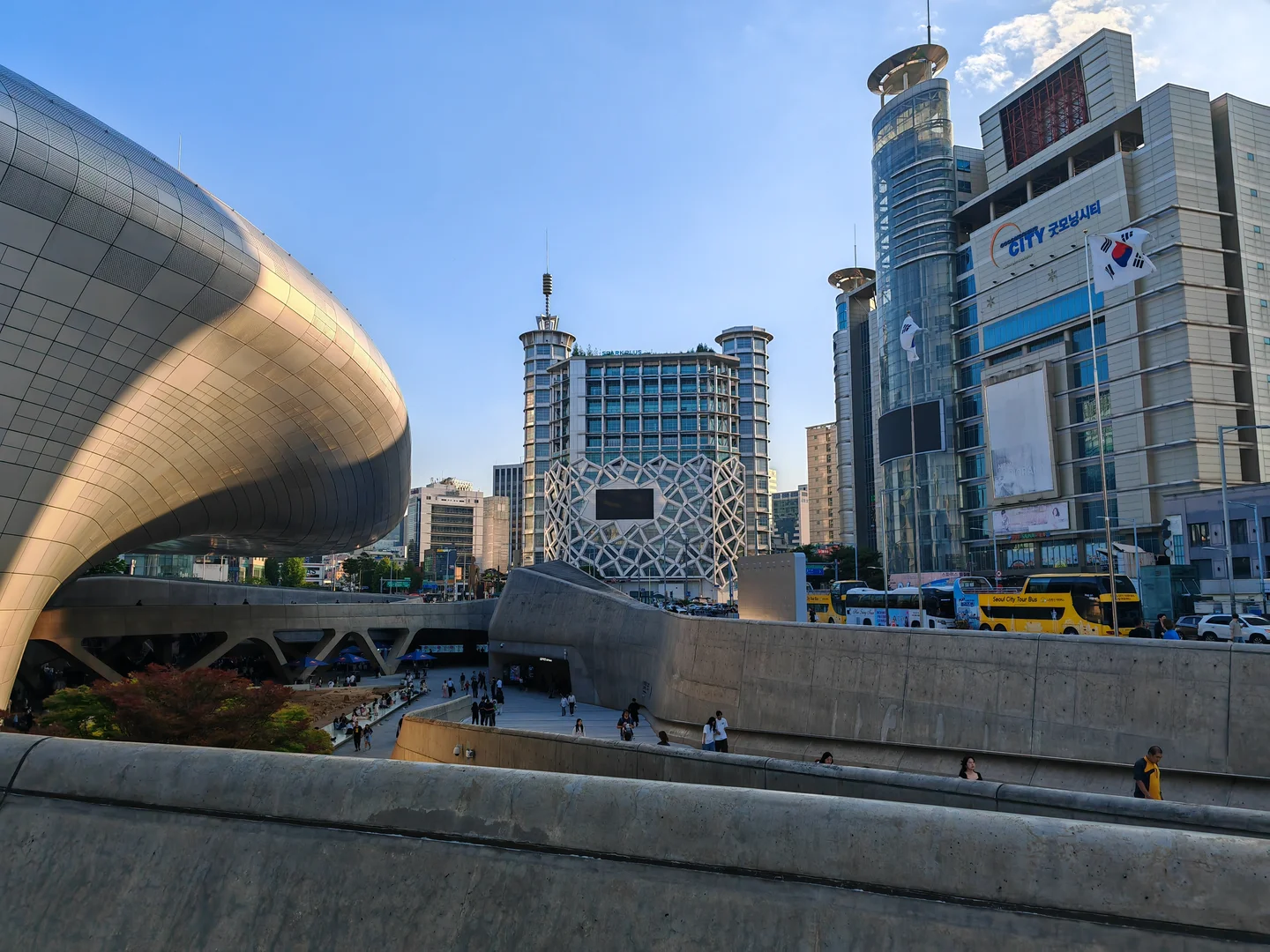
Dongdaemun rewards looking at Seoul at two very different scales. At Dongdaemun Design Plaza, usually called DDP, sweeping metal surfaces curve over plazas and pedestrian routes. A walk north brings you to Heunginjimun, the old east gate, where heavy stonework and a protective outer wall explain how the city once defended itself. Between them are the broad roads and shopping buildings of a district still organized around trade.
Architecture and design are good reasons to come even if shopping isn't on your list. DDP's exterior can be enjoyed as a walk, while exhibitions add an indoor focus. The nearby water gate and city wall give the area historical depth without requiring a full day of museum visits. For a manageable first outing, connect DDP, the archaeological remains and Heunginjimun, then decide whether to climb the hill beyond the gate.
If the evening architecture is your main interest, reverse that route. Start with the gate and wall while there's daylight, then finish around DDP after dark. Indoor exhibitions and outdoor lighting follow different schedules, so a late visit doesn't offer exactly the same experience as a daytime one.
Which Dongdaemun station should you use?
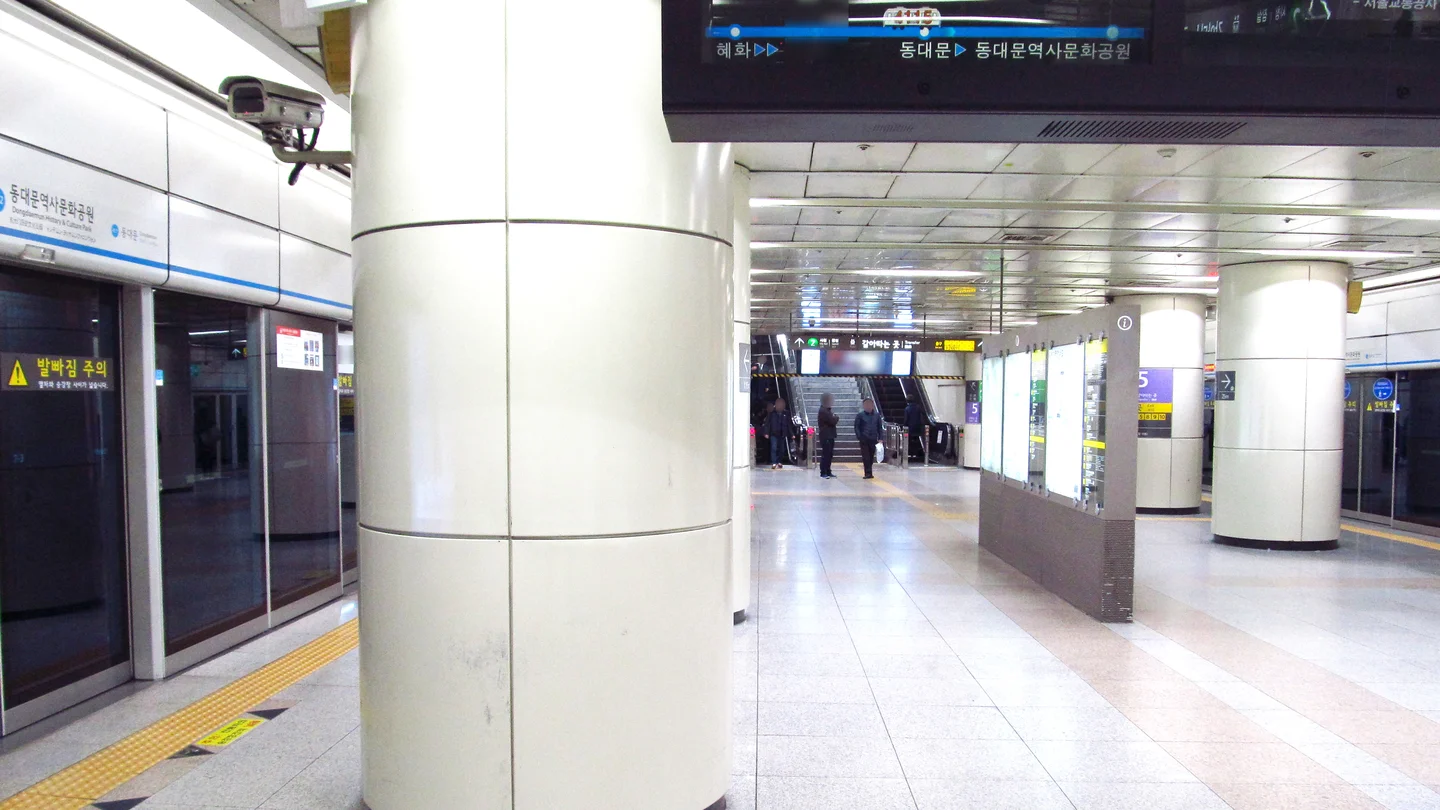
Line 4 platform at Dongdaemun History & Culture Park Station
For DDP, use Dongdaemun History & Culture Park Station on Lines 2, 4 and 5. Exit 1 is the approach listed by Seoul's visitor guide. Dongdaemun Station, on Lines 1 and 4, is a separate station closer to Heunginjimun. The distinction matters when meeting someone or choosing where to finish the walk.
DDP itself is large, with paths moving between street level, lower plazas and indoor spaces. An exhibition ticket's hall name is a better destination than a general pin for the building. Save the entrance information and allow time to find the correct level.
An information map also helps with step-free routes. Elevators and ramps are more useful guides than the apparent straight-line distance across the complex. If you add shopping, choose a particular building and product category: Dongdaemun includes both wholesale and retail businesses, with different opening patterns and rules on single-item purchases. Its reputation for night shopping doesn't mean every store stays open late.
Walk around DDP rather than looking for one front facade
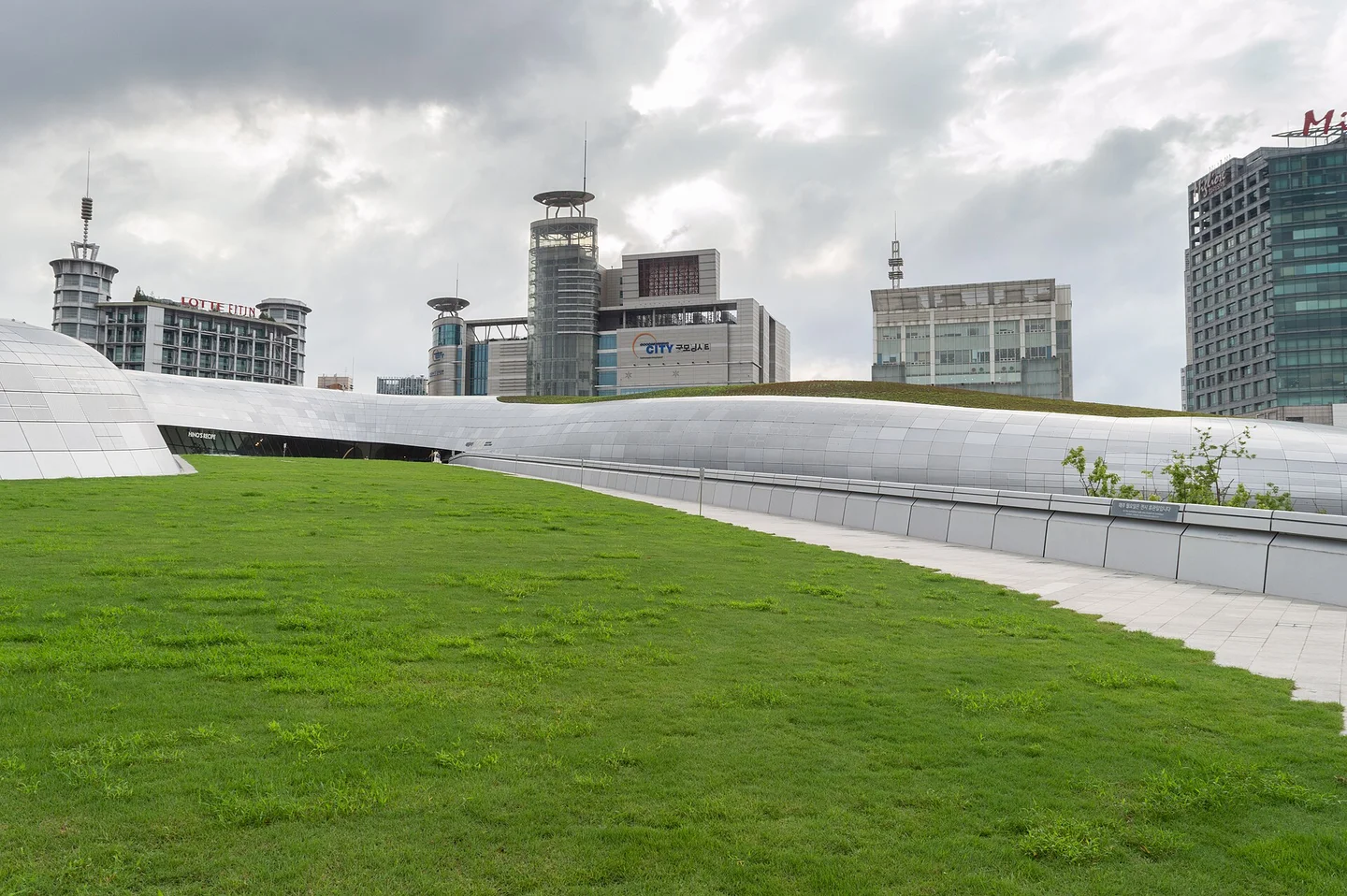
Designed by Zaha Hadid and opened in 2014, DDP is a building whose shape keeps changing as you move. Close up, individual metal panels establish a fine pattern; from farther away, they merge into broad, almost continuous curves. The meeting of roof, planted areas and pedestrian paths is especially interesting because the boundaries are less obvious than on a conventional rectangular building.
Follow the designated routes to see those changes from different levels. Visible grass and curved roof surfaces aren't all public walking areas. You can understand the architecture without treating every slope as a place to climb.
For an exhibition-centered visit, choose the show first and use the outside walk as its setting. On hot days, the indoor portion can break up time in the exposed plazas. Rain also changes the experience: some connections are outdoors, so DDP isn't an all-weather indoor circuit simply because it's one complex.
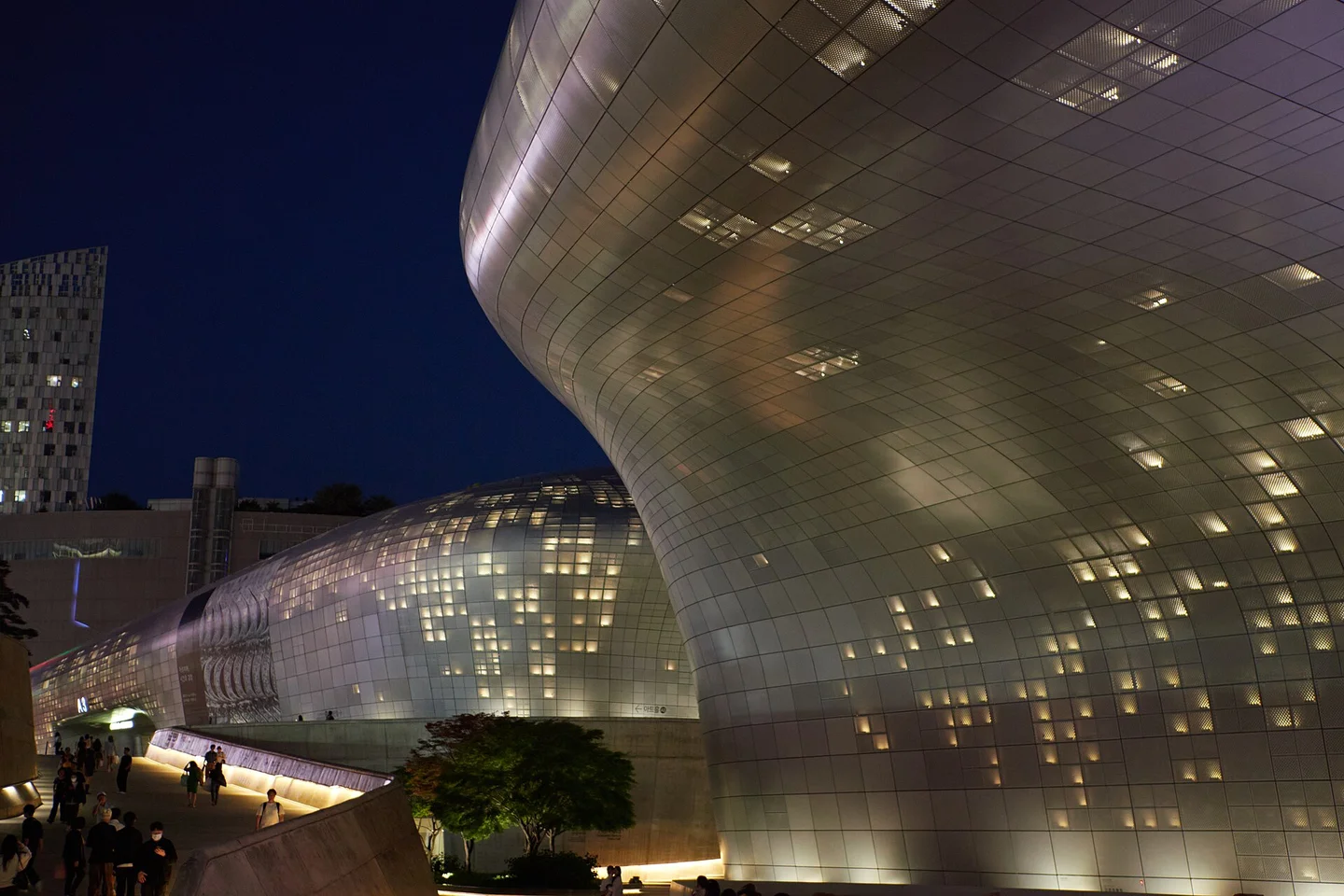
DDP after dark
At night, light picks out different parts of the metal skin and the spaces beneath it. The curving paths make the building feel different from a single illuminated monument viewed from one spot. A short loop can be rewarding, particularly if you've already seen the same surfaces in daylight.
Separate the regular evening setting from a particular media-art event. Large-scale facade projections shown online may belong to a limited festival or exhibition, not a nightly program. If a specific show is the reason for your visit, use DDP's current event listing to check the date, venue and admission conditions.
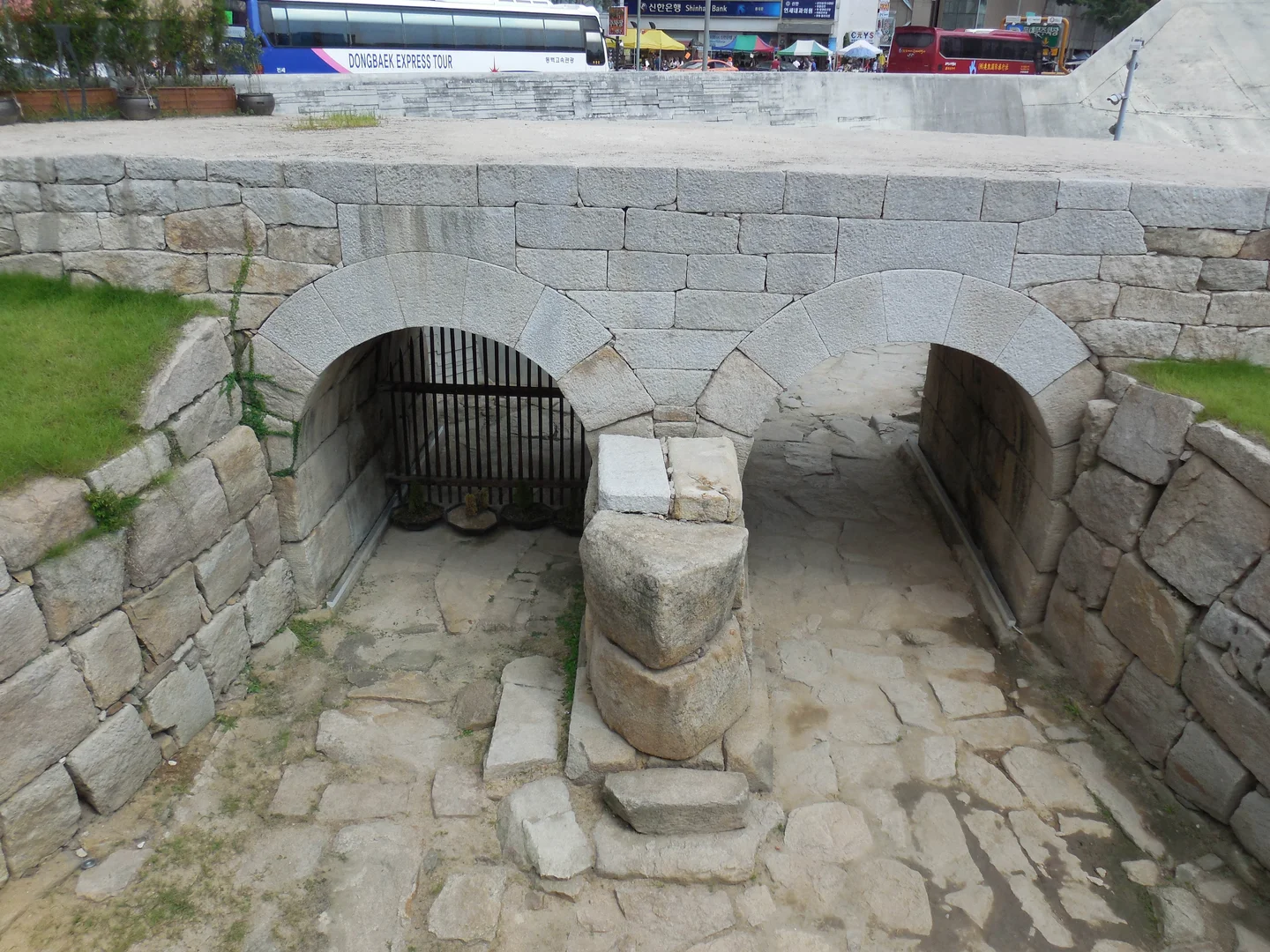
In Dongdaemun History & Culture Park, Igansumun Water Gate brings the old city into view beside the contemporary complex. Its two stone arches allowed water flowing from the Namsan area to pass through the city wall. The remains emerged during the removal of the former Dongdaemun Stadium.
The gate answers a practical question that grand palace buildings don't: how did a walled city let water out? Notice the paired openings and the difference between the archaeological level and today's surrounding streets. The structure has a purpose and context beyond being an attractive stone feature in a park.
The nearby Dongdaemun History Museum offers more background on the excavated site and the former stadium. Add it if the history interests you, keeping its indoor visiting hours separate from access to outdoor paths. A shorter route can simply pause at the water gate before continuing north.
Heunginjimun and its protective curve
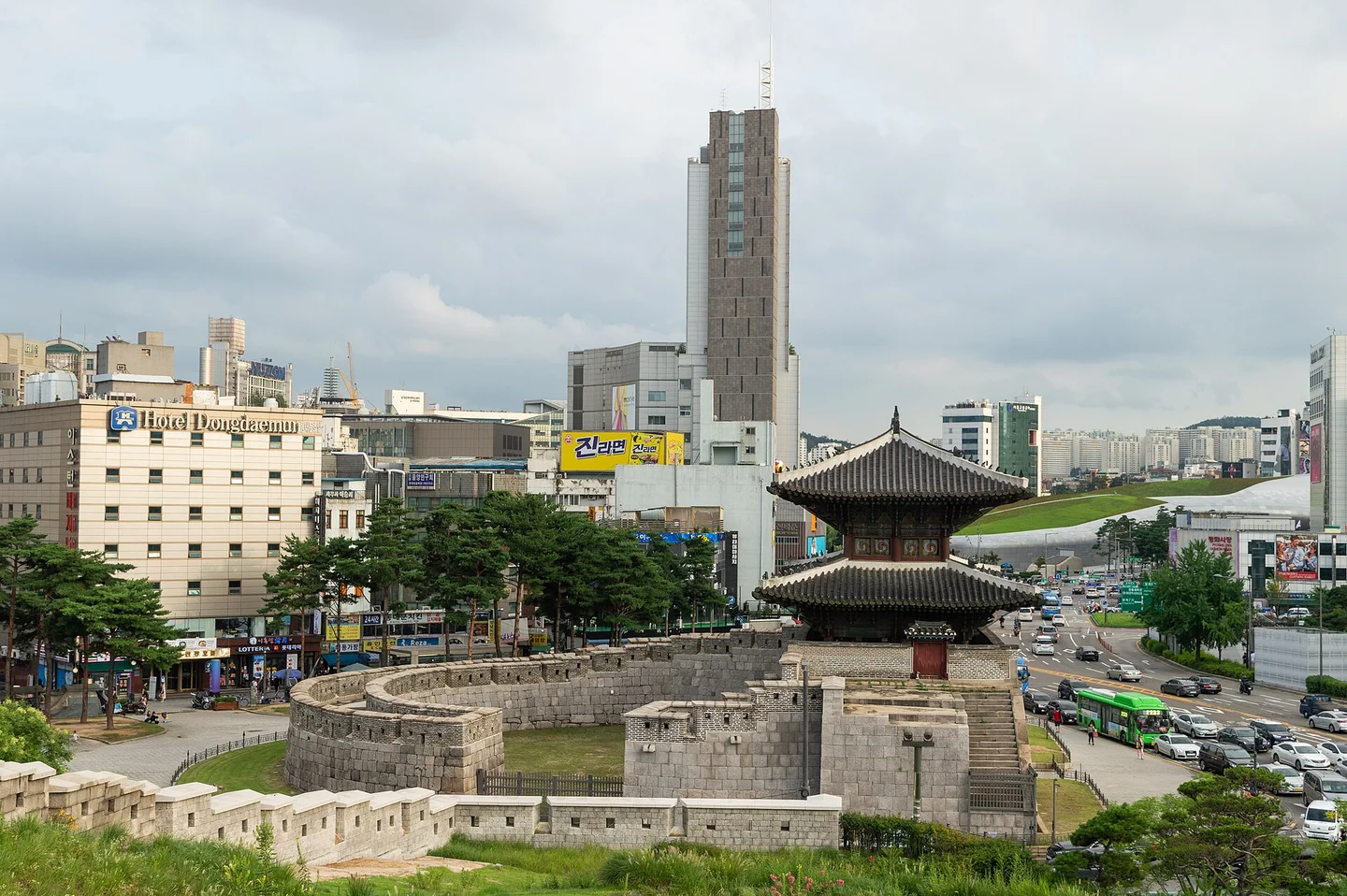
Heunginjimun Gate within its outer wall and the surrounding city
Heunginjimun is the gate commonly known as Dongdaemun, or “Great East Gate.” The present structure was rebuilt in 1869. Its most revealing feature is the curved outer defensive wall, called an ongseong, which partially encloses the gateway. Look beyond the tiled pavilion to see how that wall protected the entrance.
Getting here from DDP involves a city walk past major roads and across the Cheonggyecheon area. Use the marked crossings; the gate may be visible before the pedestrian route reaches it. Plan on viewing the monument from outside rather than assuming the pavilion or passage is open for exploration.
Continue uphill in Heunginjimun Park
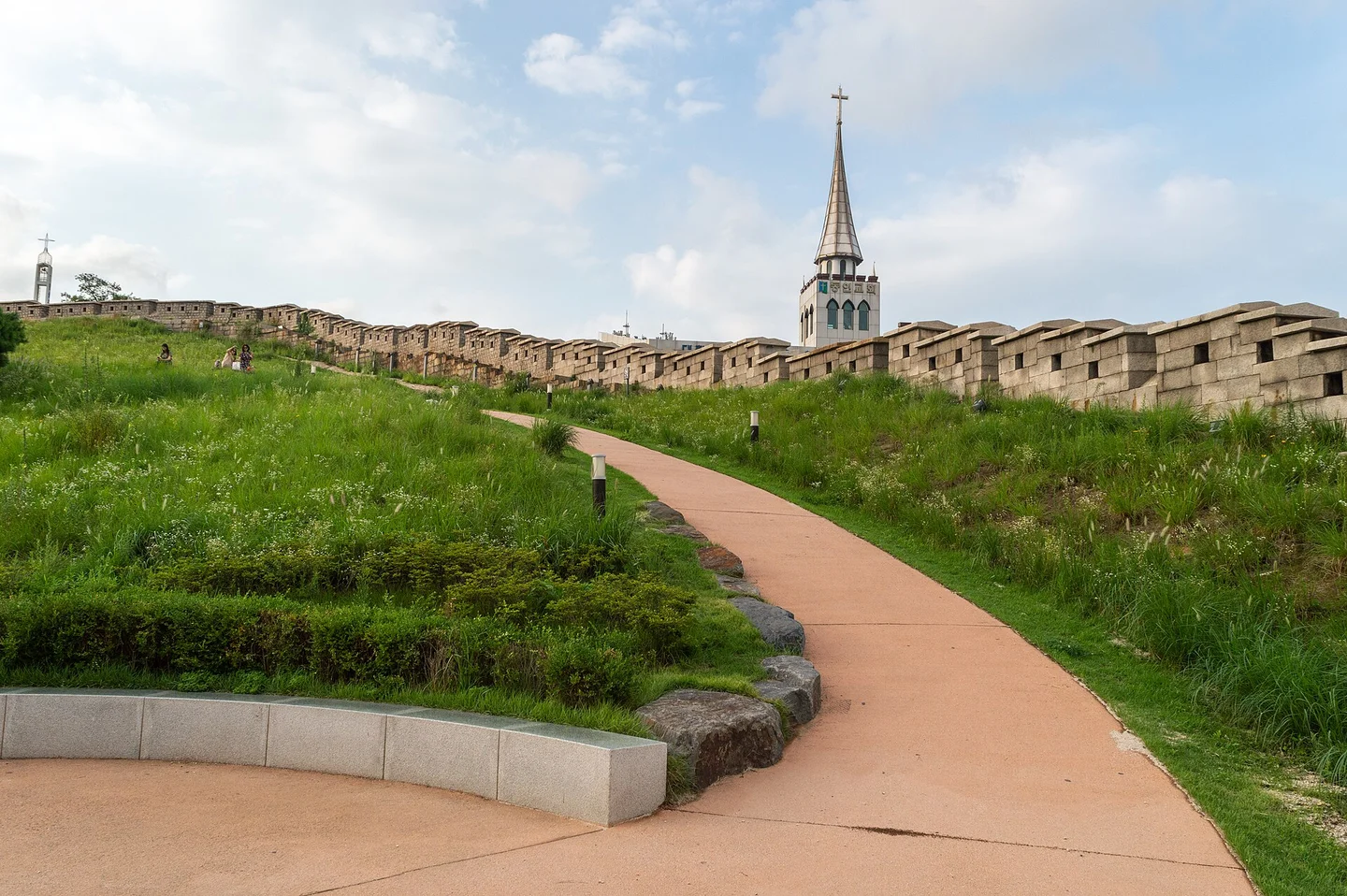
The park beside the gate follows the Seoul City Wall uphill. Even a short climb changes the view, placing the gate's stone enclosure against the surrounding commercial buildings. It is a worthwhile finish for anyone who enjoys seeing how Seoul's historic structures fit into the modern city.
This section adds a real incline after the plazas and street crossings. You can climb a little and return to Dongdaemun Station, or make the wall toward Naksan the next stage of a longer walk. After an exhibition and shopping, stopping at the gate may be enough.
The route works because its places explain different aspects of the same district: DDP for contemporary design, Igansumun for the old city's infrastructure, and Heunginjimun for its defensive edge. Give the part that interests you most the time it deserves, with the others forming a connected walk around it.
Sources서울관광 DDP: https://korean.visitseoul.net/attractions/Dongdaemun-Design-Plaza-kr_/24679
서울시 DDP 정책 아카이브: https://www.seoul.go.kr/policy/view.do?id=99&lan=KO
서울한양도성 동대문 구간·이간수문: https://seoulcitywall.seoul.go.kr/content/134.do
국가유산포털 서울 흥인지문 안내판: https://heritage.go.kr/heri/cul/culGuidePostDetail.do?ccbaCpno=1121100010000&ccgbGbtype=IND&ccgbGbtypeNo=1&pageNo=1_5_0_0
서울관광 동대문 쇼핑타운: https://korean.visitseoul.net/shopping/%EB%8F%99%EB%8C%80%EB%AC%B8-%EC%87%BC%ED%95%91%ED%83%80%EC%9A%B4/KOP000061
DDP English visitor guide and station approach: https://english.visitseoul.net/dongdaemunarea/dongdaemun-design-plaza-en_/24680
City wall and gate English guide: https://seoulcitywall.seoul.go.kr/_data/guidebook_en.pdf
확인일: 2026-10-12 (Asia/Seoul). 기본 근거: seoul-006 한국어 완료 원고의 사실·선택 사진. 영어는 독립 구성·집필.